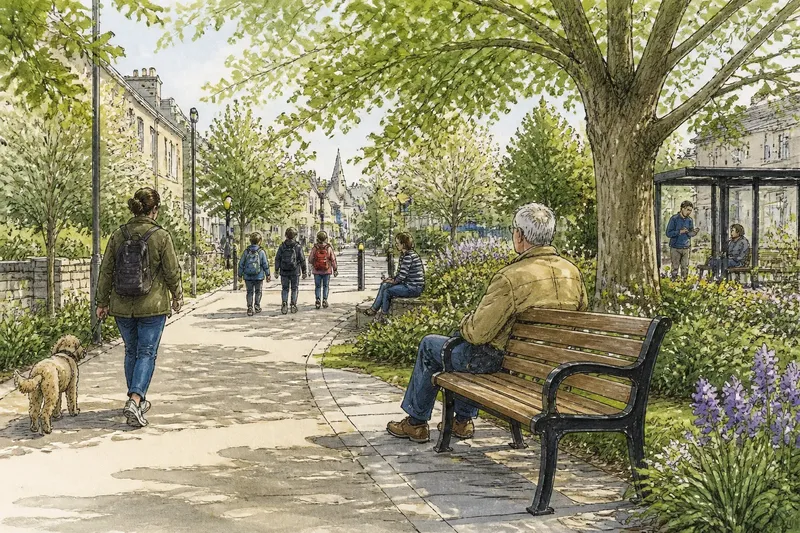
Welcome by Invitation or by Open Door?
Compare a personal invitation with an open-access gathering and choose the welcome that helps newcomers feel expected without creating hidden rules.
The common mistake with a neighbourhood welcome is assuming that an open door makes everyone feel invited. It can leave newcomers unsure whether they belong; a personal invitation can help, but may make the gathering feel closed to anyone whose name was missed. A thoughtful welcome by invitation or open door depends on what each signal says and how people can join.
Begin with the signal the gathering sends
Imagine a fictional neighbourhood association arranging a simple evening gathering in a community hall. New residents have arrived on several streets, and the organisers want them to meet neighbours without turning the event into a formal reception. They have two options: ask existing residents to invite someone personally, or publicise a drop-in gathering open to anyone nearby.
A personal invitation carries a clear message: somebody has thought of you and expects you to come. It can make a first arrival easier, especially when the invite names a person who will meet the guest at the door. It also creates a boundary, intended or not. A newcomer who hears about the event afterwards may conclude that it was for established residents.
An open-access gathering sends a different signal: attendance does not depend on knowing an organiser. A notice on the hall door, a local newsletter item or a message shared through a residents’ group can make entry seem ordinary. But an open invitation may remain abstract. Someone standing alone outside may still wonder whether “everyone” includes them.
These approaches are not opposites. The organisers can make the gathering open to all while asking neighbours to offer personal invitations. The distinction is between who is eligible to attend and who receives a direct sign of welcome.
Make the fictional welcome open, then make it personal
In this invented situation, the organisers choose a drop-in event at the community hall, with no registration and no expectation that visitors stay for the whole evening. They put the date and entrance details on a notice where residents already look, and ask each block representative to invite new neighbours directly. The invitation says that anyone from the neighbourhood is welcome, not only the named recipient.
They also give the personal invitation a practical shape. Rather than saying only, “You should come,” a neighbour offers to walk in with the newcomer or meet them beside the entrance. That small commitment turns welcome into an observable action. The visitor need not search a crowded room for a familiar face.
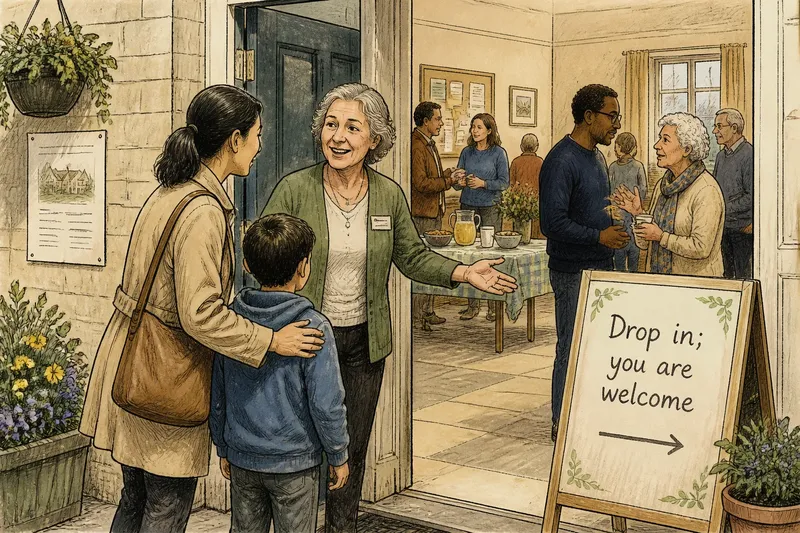
At the hall, a greeter stands where the entrance is easy to find. A handwritten sign says “Drop in; you are welcome” and points towards the refreshments and seating. The greeter explains who is hosting and what is happening, without asking visitors to introduce themselves to the whole room. No one has to give a speech, sign a list or explain why they came.
The arrangement uses an everyday-object analogy: the open invitation is like leaving a chair available, while a personal invitation is like drawing it out for someone. The chair is available to everyone; the gesture helps one person see that there is room for them.
Notice who can act on each invitation
As the fictional evening begins, the organisers pay attention to the route into the room, not to who seems sociable. A newcomer might arrive alone, come with a child, or be more comfortable listening than talking. The welcome should not treat any of these choices as a failure to participate.
They keep the gathering legible. A short spoken welcome explains that people can get refreshments, chat, or simply look around. The host names a few available activities rather than assuming visitors know the group’s customs. If there is a customary way to contribute, such as bringing food or joining a discussion, the organisers say plainly that it is optional.
Here is the invented situation’s turning point: one resident has not received a personal invitation but sees the notice and arrives alone. The greeter welcomes them, explains the informal format and introduces them to a neighbour who has offered to chat. The expected observable result is not instant friendship; it is that the visitor can enter, understand what is happening and choose how long to stay without having to prove a connection.
Meanwhile, the neighbour who invited a new resident keeps the promise to meet them at the door. That guest has a named point of contact, while the uninvited visitor has an equally clear route in. The two forms of welcome serve different needs without making one a condition of the other.
Choose the form that fits the community’s purpose
Use a personal invitation when the main barrier is uncertainty about arriving alone, when a gathering relies on conversation, or when a trusted neighbour can offer a genuine welcome. Avoid making attendance depend on private networks. If organisers can only invite people they already know, an invitation-only approach can reproduce the very gap the gathering is meant to close.
Use an open-access format when the purpose is to meet a broad neighbourhood, share information or let people drop in at a convenient time. Make the invitation visible in places newcomers can reasonably encounter, and say who is welcome. An “open” event that is advertised only through an established group may remain open in principle but hard to discover in practice.
For many civic rituals, combine both: public access, plus personal outreach. This is especially useful when attendance may be unfamiliar or the venue is not self-explanatory. The personal invitation creates expectation; the open notice makes clear that the welcome is not exclusive.
What should a newcomer be able to tell?
Does an open invitation mean anyone can come?
It should say plainly who the event is for and whether visitors can simply arrive. If the gathering has a genuine limit or a particular purpose, explain that before someone makes the journey.
What makes a personal invitation feel welcoming?
Make it specific: say where and when to meet, offer to arrive together, and clarify that there is no pressure to stay. A vague suggestion can sound like politeness rather than a real invitation.
How can organisers welcome people who arrive alone?
Put a greeter near the entrance and give them a simple role: explain the event, point out the room and offer an introduction without insisting on one. Visitors should be able to decline conversation and still feel welcome.
Can a gathering be both open and personal?
Yes. Publicise access broadly, then invite neighbours directly as an added gesture rather than as a gatekeeping step. Keep the wording consistent so nobody thinks they need a personal connection to attend.
Read the result without mistaking attendance for belonging
In the invented scenario, the organisers see that people could find the entrance, understand the informal format and choose whether to join in. They also notice which part of the welcome helped: a clear notice, a greeter or a neighbour’s offer to walk in together. Those observations can guide the next gathering, without treating a busy room as proof that every visitor felt at home.
The practical lesson is to separate access from reassurance. Open-access gatherings tell people they are entitled to come; personal invitations tell particular people they are expected. When both signals are honest and visible, a newcomer can arrive without an insider’s permission and still find someone ready to welcome them.
For a welcome by invitation or open door, decide who may attend first, then decide how to help a new arrival cross the threshold. A clear public invitation and one genuine offer of company can do both jobs without making belonging depend on a private introduction.