A Neighbourhood Walk for Reading Civic Language
A neighbourhood walk for reading civic language helps you notice who names, welcomes and remembers a place—and what one sign cannot tell you.
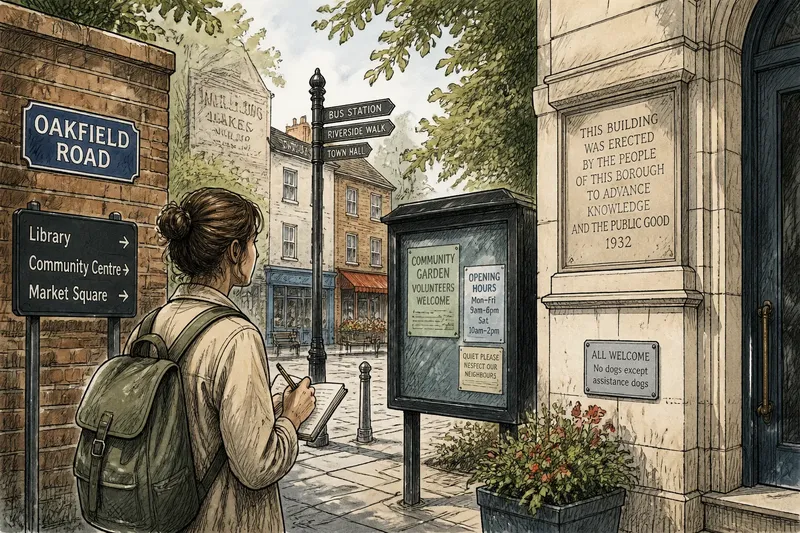
The common mistake on a neighbourhood walk is to treat the first plaque or street sign as the whole story. That shortcut can leave you with a tidy account that misses who chose the words, who they address and what nearby wording complicates them. A neighbourhood walk for reading civic language is more useful when you follow the language across several places, recording what is visible without pretending to settle what it means.
Think of signs as labels on drawers: each tells you something about what is inside, but none describes the whole room. Names, inscriptions, notices and directional signs do different jobs. Read them in context, and the walk becomes a way to ask better questions about belonging rather than a hunt for a single definitive answer.
Choose a route that matches what you want to notice
Start with a short route you can walk at an unhurried pace. A high street, a route from a bus stop to a library, or the edges of a public square may offer enough varied wording without turning the walk into an expedition. Pick a route you already know if you want to notice familiar language afresh; choose an unfamiliar nearby route if you want to compare how different parts of the area address the public.
Before setting out, decide what kind of language you are looking for. You might focus on names, public instructions, welcome messages or inscriptions. One focus keeps your notes legible, while leaving room to record other wording that catches your attention. Bring a notebook or use a notes app. If you photograph signs, avoid including identifiable passers-by and follow any posted restrictions.
- For a quick orientation, follow a route with street names, destination signs and public notices.
- For a closer look at how a place presents itself, include a square, library forecourt or community building entrance.
- For a route shaped by everyday movement, walk between a stop, a shopfront and a public service, noting how the wording changes.
Do not choose a route merely because it contains a prominent monument. The quieter wording on a noticeboard or entrance can show how people are addressed in ordinary situations.
Read names as choices, not neutral labels
Street names, building names and names on maps make places easier to identify, but they also select what becomes visible. Note the exact wording, where it appears and whether it is repeated elsewhere. Ask what kind of name it is: a person, a place, a trade, a natural feature or something less direct. Then notice what the name does not explain.
A name alone cannot tell you who proposed it, how residents use it or whether an older name remains in conversation. Mark those as open questions rather than filling gaps with assumptions. If a local map uses one name and a building sign another, record both and where each appears. That difference is an observation, not proof of disagreement.
Pay attention to pronunciation hints, translated forms and spelling choices where they appear. These details can suggest whom the sign anticipates as a reader, though they do not reveal every reader’s experience. If you are unsure how to say a name, write it down accurately and seek a reliable local source later rather than guessing aloud as if your guess were settled.
Compare what inscriptions remember with what notices ask
An inscription often points towards memory: it may name a person, event, organisation or purpose. A notice usually manages present activity, such as opening hours, access or conduct. Read both, but do not ask them to do the same work. The inscription may offer a carefully chosen account; the notice may show what the institution needs visitors to know now.
Look for where the wording sits. Is it at an entrance, on a wall people pass, or beside the object it describes? Is it easy to read from the pavement, or set where a visitor must stop? Record practical details such as language, placement and whether the text directs readers elsewhere. These observations help explain how the words meet people in motion.
Then compare neighbouring messages. A formal dedication beside a plain instruction can show two different voices sharing one site. A temporary notice may make a building’s routine visible in a way a permanent inscription does not. Neither voice automatically cancels the other. Keep the contrast in your notes and avoid deciding that the shorter or older wording is necessarily more truthful.
Sort your walk by the situation you are in
If you are walking alone and want a simple record, use brief notes: exact words, location, sign type and one question. This suits a first pass because it separates what you saw from what you think it means. Save interpretation for later, when you can compare several entries.
If you are walking with children or companions, invite each person to choose one sign and explain what they think it asks or tells a passer-by. This suits a shared walk because different readers may notice different cues. Keep the conversation open: ask what in the wording led to that reading, rather than treating one person’s response as the correct account.
If you are documenting language for a community discussion, make a small, organised record rather than collecting striking lines without context. Note the location, date of observation, exact wording and whether the sign appears permanent or temporary. This makes it easier for others to check what you mean, while keeping the record distinct from claims about the sign’s history or reception.
If you are considering a public response to wording you find troubling, first identify the specific text and the question it raises. Is the issue a missing translation, an unclear instruction, a name that needs context, or something else? This situation calls for careful description before advocacy; ask the relevant local organisation how comments are received, and distinguish a request for information from a proposal to change the wording.
What should you record, and what should you leave open?
Should I photograph every sign I notice?
No. Record only what serves your chosen focus, and include enough surrounding context to locate the wording later. A clear written note can be more useful than an image that captures the words but not their placement.
How can I tell who a sign is addressing?
Look at its wording, location, language choices and assumed knowledge. Treat these as clues about an intended reader, not proof that every person nearby reads it in the same way.
What if two signs give different names for the same place?
Write down both forms and where each appears, then note whether one is on an official map, a building, or an informal notice. The difference may have several explanations, so look for a dependable local source before assigning a cause.
Can a walk reveal a sign’s full history?
No. A walk can show what is present, how it is placed and what nearby wording adds or leaves out. Historical context may require local archives, council records or a conversation with people who know the site.
Turn observations into questions without claiming too much
After the walk, group your notes by type: names, inscriptions, directions, instructions and welcome messages. Within each group, separate direct observations from questions. For instance, “the entrance sign uses two languages” is an observation; “the wording was added because residents requested it” is a claim that needs a source.
Say you walk from a bus stop to a local library and see one street name repeated on a map, a dedication beside the entrance and a notice about access. You note where each appears, copy the wording and mark one question about who the notice is meant to help. The expected result is a compact record that lets you compare public language without treating any single sign as a complete account.
If you plan to share your notes, explain the route and the limits of what you observed. Do not present a photograph or transcription as evidence of local consensus. If the wording concerns a living person, a sensitive community issue or a disputed account, take particular care with context and seek appropriate local guidance before publishing an interpretation. Where rules for photography or access depend on a site’s instructions or local requirements, follow those instructions.
A neighbourhood walk for reading civic language works best when you leave with precise observations and honest questions. On your next route, choose one phrase you would normally pass without noticing, record where it meets the public, and ask what nearby language changes about its meaning. That small habit keeps the place larger than any one sign.