Before the Plaque: How Communities Remembered a Place
Before the plaque, communities remembered places through stories, repeated observances and shared care; learn how these forms carried memory and what changed.
The common mistake is to treat a plaque as the beginning of a place’s public memory. Before the plaque, communities remembered through spoken accounts, recurring observances and practical acts of care; overlooking those forms can make a settled place seem to have had no story until someone fixed words to stone.
These forms did different work. A story connected a location to a person or event. An observance brought people back to it. A permanent marker made one account easier to encounter, but also gave it a more fixed public presence. Understanding the sequence helps a community ask not only what to commemorate, but whose memory already lives there.
How did a place become memorable before a marker existed?
A place became memorable through repeated use and repeated telling. People linked an event to a bridge, meeting room, field, street corner or shoreline, then carried that association into everyday conversation. The location was not merely a backdrop: it helped listeners picture where something happened and pass the account to others.
Oral memory often travelled through several versions. A relative might tell a story at home; a neighbour might add a detail learned from someone who was present; a local group might return to the site during a gathering. Changes in wording did not always mean the account had lost its meaning. They could show how each generation made the memory understandable to its own listeners.
Places also acquired meaning through ordinary routines. A route used for an annual procession, a room where a group met, or a patch of ground tended by local residents could become associated with shared effort. Such associations were not necessarily announced in a formal ceremony. They could be recognised because people knew how the place was used and why they came back.
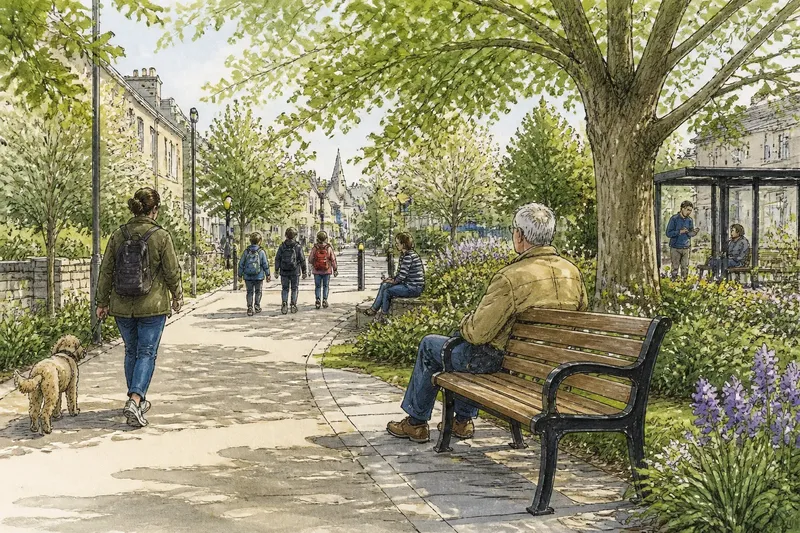
That kind of memory can be hard to see from outside. A visitor may see an unmarked wall; a resident may know it as the spot where neighbours gathered to pass news or organise help. The absence of a plaque does not mean the absence of public meaning. It may mean that the memory has been carried by people and practice rather than by an object.
What did repeated observances add to local memory?
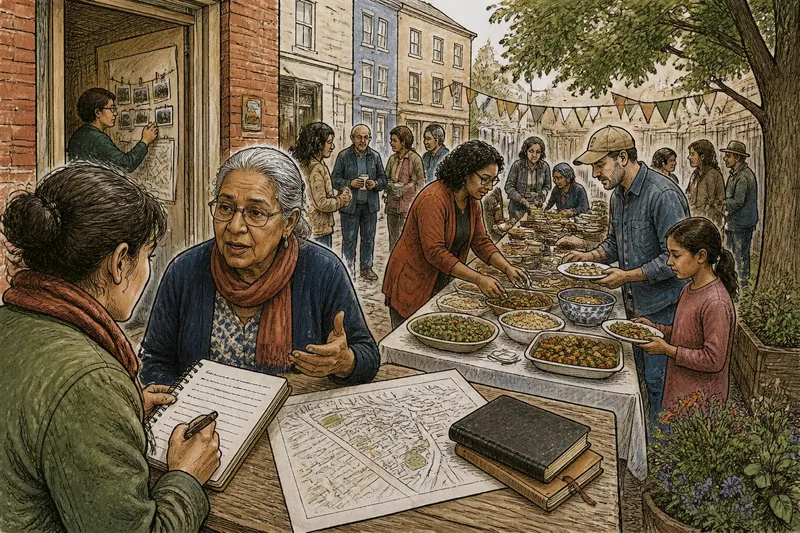
A recurring observance turned recollection into a shared appointment. People met at a particular place, followed a familiar pattern and made time for an account to be heard again. The pattern could be a walk, a gathering, a song, a moment of silence or the tending of a communal space.
Repetition gives memory a social shape. Someone who did not witness the original event can still take part in the act of remembering. They learn which place matters, what is recalled there and how the community chooses to acknowledge it. The observance does not make every participant remember in the same way, but it gives them a common occasion on which to meet the memory.
These practices may shift as people and circumstances change. A gathering can move indoors in bad weather, acquire new speakers or become less formal. A group may alter the order of events to make room for a different account. Such changes can preserve the reason for meeting while changing the way it is expressed.
It helps to distinguish a recurring observance from a record. An observance brings people together in the present; it does not necessarily leave a full account of what happened or why. A community that wants the memory to be accessible beyond those who attend may also preserve oral accounts, programmes, photographs or written descriptions, with appropriate permission.
Why did communities choose permanent public markers?
A permanent marker made a selected memory visible without requiring a storyteller or an annual gathering. A plaque, inscription, stone or other public sign could identify a person, event or purpose for people passing through. Its fixed location gave the account a durable point of reference, while its concise wording made the subject available at a glance.
That durability also changed the character of remembrance. Spoken accounts could be expanded or questioned in conversation; an inscription presented a particular version in a lasting form. The choice of location, name, wording and symbols shaped what a passer-by could learn. A marker therefore recorded a memory, but it also signalled that certain people had the means or authority to place that memory in public view.
This does not make permanent markers a mistake. A clearly placed marker can help people find a story they might otherwise never encounter. The important distinction is between a marker as one part of memory and a marker as the whole of it. Adding context nearby, linking to a fuller local account or retaining an annual observance can show what a short inscription cannot.
A useful everyday analogy is a bookmark. It helps a reader return to a passage, but it does not contain the whole book. A plaque can similarly direct attention to a place or account while leaving the wider story to people, records and ongoing discussion.
How can a community trace what came before a plaque?
Start with the place and the people who use or remember it, rather than treating the marker as the only reliable source. Ask what accounts were told, what gatherings took place and what practical routines connected the community to the location. Then compare those memories with available local records, keeping different kinds of evidence distinct.
- Ask long-term residents what they recall. Invite them to describe who told them the account, where it was told and which details they consider uncertain. Record permission and preferred attribution before preserving or sharing an interview.
- Look for recurring observances. Check community calendars, group records, programmes and local noticeboards for gatherings connected to the site. Ask organisers how the practice began and whether its purpose has changed.
- Consult local collections. A library, community archive or local history group may hold photographs, meeting notes, maps or correspondence. Treat each item according to what it can actually establish, rather than asking one document to settle every version of a story.
- Compare the marker’s account with other accounts. Note whose names appear, which events are described and what is left unexplained. Share questions with people connected to the place before proposing new wording.
- Keep uncertainty visible. If accounts differ, record that they differ and say what is known about their sources. A careful description is more useful than smoothing disagreement into a single confident story.
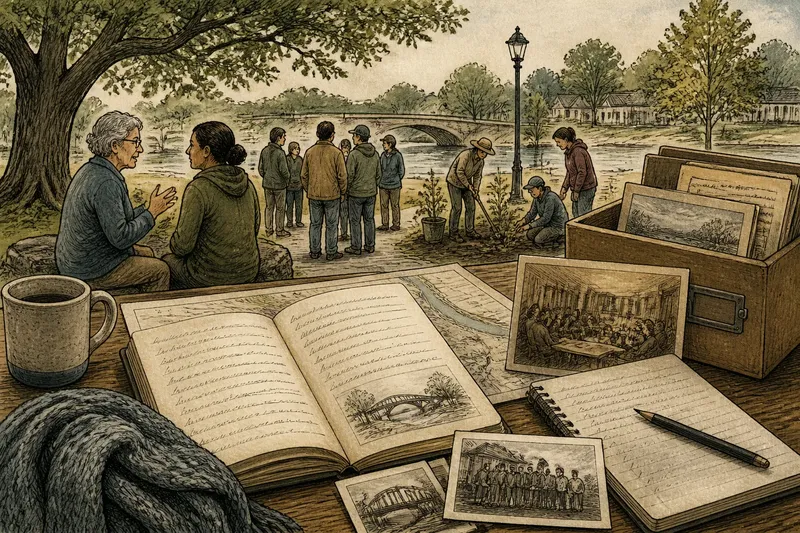
Say a residents’ group wants to understand why an old riverside path is linked to a yearly gathering. Members speak with people who have attended for years, ask a local archive to check its photographs and meeting papers, and compare the accounts without assuming they will match. They expect to produce a short, attributed description of what is shared and what remains uncertain, rather than declare one version definitive.
What should a community do when memories disagree?
Keep the disagreement legible and look for the reason behind it. People may differ over a date, a person’s role, the name used for an event or the meaning of the place. Some differences arise because witnesses saw separate parts of what happened; others reflect later interpretations or gaps in the surviving record.
First, separate a factual question from an interpretation. A question about where a meeting occurred may be approached through records and testimony. A question about what that meeting meant to the community may have several honest answers. Naming the type of question prevents a discussion about values from being mistaken for a simple failure to find a date.
Next, make room for accounts that have not previously been heard. People may have been left out because they were not part of the organisations that kept formal records, or because their memories were passed within families rather than presented publicly. Listening does not mean treating every claim as equally supported. It means asking whose evidence is available, whose is missing and why.
If a marker is already in place, a community can add explanation without pretending its wording has never shaped public understanding. That may involve a companion notice, a public discussion, an accessible local record or a revised inscription after careful consultation. The choice depends on the place and the people affected; where ownership, permissions or local rules apply, check them with the relevant authority.
How can a community keep memory alive without fixing it forever?
Pair durable records with opportunities for people to revisit them. Keep oral accounts with clear descriptions of who is speaking and when the account was recorded. Preserve the programme or notes from a recurring observance. Make it possible for residents to suggest corrections or add context, while retaining earlier versions so changes remain understandable.
A public marker need not carry every detail. Its wording can identify the subject and point towards a fuller account held by a library, archive or community organisation. The fuller record should be easy to find and written in language that readers outside the original group can follow. Accessibility matters too: consider whether a person can encounter the information without being able to stand close to the marker or read small lettering.
Review can be part of care rather than a verdict on the past. A community might revisit the wording when an observance changes, when new records become available or when people point out an omission. Ask what the review is meant to address, who should take part and how the decision will be explained. A clear process can make change less like a sudden replacement and more like an accountable continuation.
What do readers ask about memory before a plaque?
Does a place need a plaque to have shared memory?
No. A story passed between residents, a recurring gathering or a familiar act of care can connect a community to a place without a permanent sign. A plaque makes one account more visible, but it is not the source of every meaning attached to the site.
Are oral accounts useful if they differ?
Yes, if they are preserved with care and their limits are made clear. Differences can show how people experienced an event from separate positions, although a claim about a specific fact may still need comparison with other available evidence.
Can a recurring ceremony change and still carry the same memory?
It can, when participants understand what the gathering is for and have a chance to discuss changes. The outward form may shift while the observance continues to bring people together around a shared account or place.
What belongs on a short public inscription?
Include enough to identify what is being remembered and why the location matters, using language a passer-by can understand. Put fuller context, contested details and sources in an accessible companion record rather than forcing a brief inscription to settle every question.
Before deciding that a place needs a new marker, ask what already brings its memory into public life. The answer may point to a story worth recording, an observance worth supporting or a gap that a sign could help fill. A plaque can make remembrance easier to encounter; the living account around it is what lets a community keep asking what the place means.